The Review of Mardi Gras 2026
What we talk about when we talk about the Mardi Gras vibes.

1. How to Love Suffering
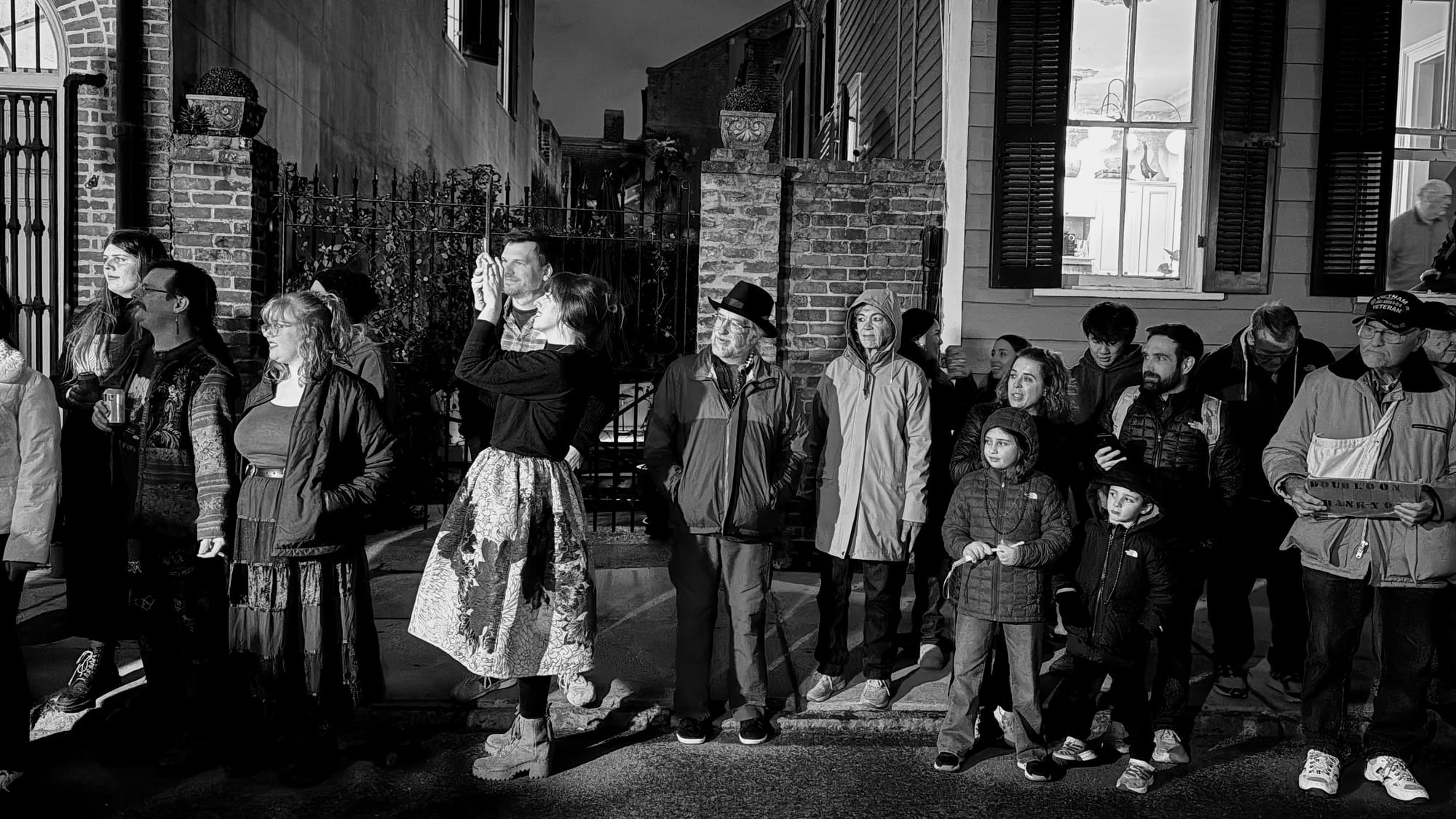
Your feet hurt. The activity tracker in your watch says you have, over the past two days, walked the equivalent of the distance between Dong Phuong, in the East, and your usual spot Uptown at the corner of Napoleon and Coliseum.
Leaving the route, your left arm hangs low from your shoulder and swings pendulum-like without your permission, put to sleep by the number of hours it supported the baby’s weight.
You freeze. At KdV, the icy air numbs your fingers in a way you haven’t experienced since you were in New York one winter and waited too long on an exposed platform for a late train.
You sweat. When the sun pops out on Tuesday, you heat up under the several layers of your costume. You leave the layers on: pain is beauty (or beauty is pain).
Carnival has Catholic roots, as you know. During this Mardi Gras season, two different friends say, “For Protestants, joy is bad; for Catholics, suffering is good.”
Shia LeBeouf prowls the streets.
You burn yourself when you reach in to check the jambalaya on Endymion morning. The cream cheese in that king cake disagrees with you. At Bacchus, you reach out to catch something at the same moment a boy darts across your field of vision. Your thumb connects with the boy’s skull. He doesn’t notice but the shock of pain rolling from your thumb up your arm rocks you and puts you into the chair your friend brought to the neutral ground, hours earlier, where you sit, trying and failing to close your fist. Your kid throws up during the walk back from Boheme because — you don’t realize it at the time — he’s got one of the mystery viruses that are just going around.
Popeye’s gets your order wrong — like, way wrong. They give you a dozen mild tenders instead of a twelve-piece spicy chicken.
Your favorite place on Mag has been overrun by Slidellians, and you can’t drink this way anymore, and you get mail from the city: NOTICE OF VIOLATION.
Your ex, looking great, marches by with that one dance krewe.
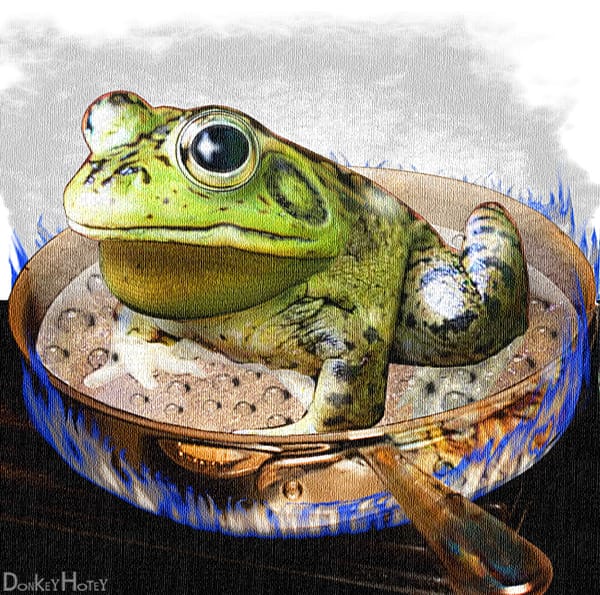
“This has been a rough Mardi Gras,” someone says, but they say this every year. It is part of the ritual. The joy and the suffering hold hands, fingers intertwined. You think of the tragedy and comedy masks; either would be incomplete without the other.
You’ve never lived a Carnival during which you, at some point, have not thought everything was the worst. And you’ve never lived a Carnival during which you, at some point, have not mourned that it would all end so soon.
2. What We Talk about When We Talk about the Vibes
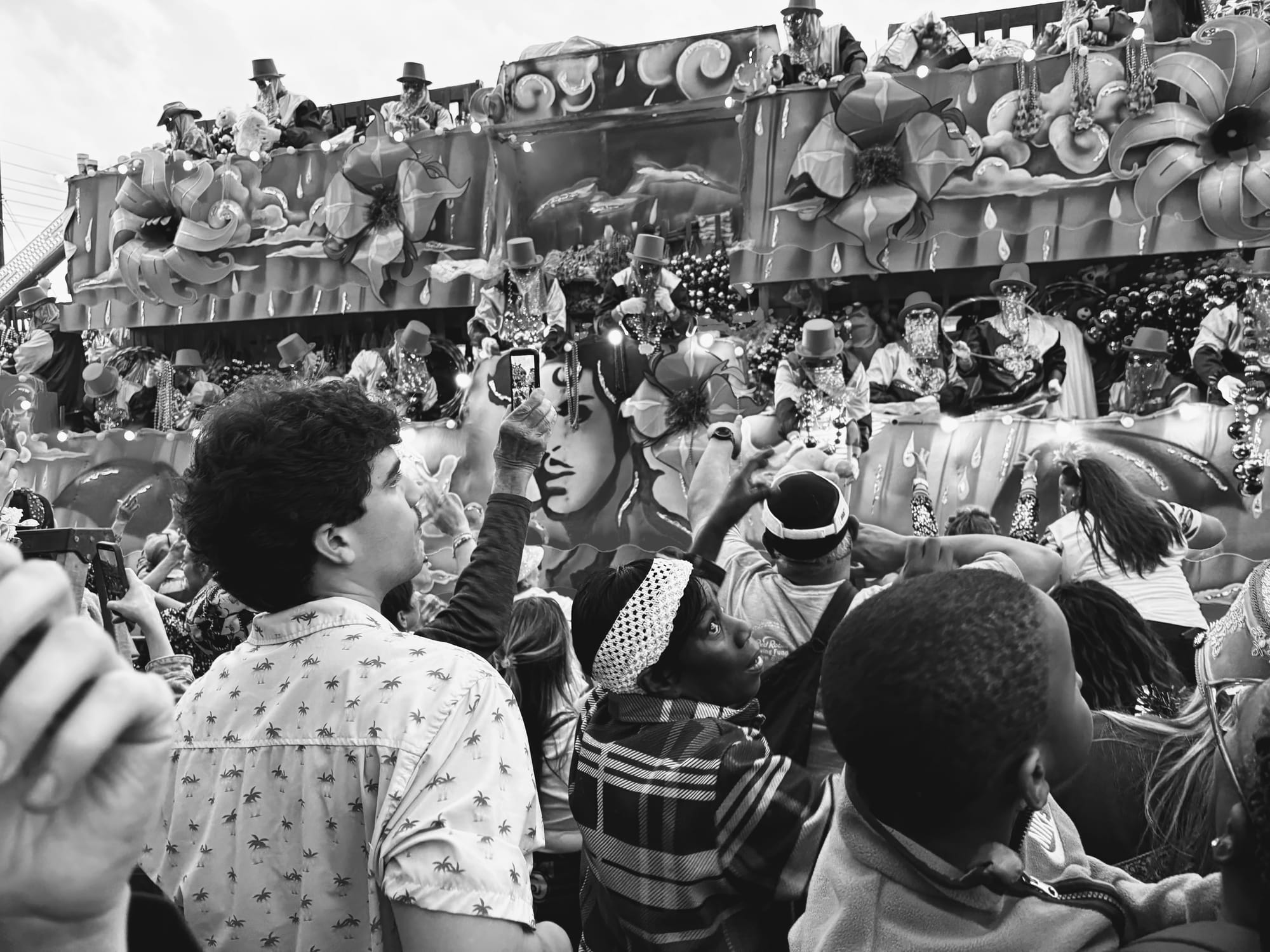
The worst vibes in modern Mardi Gras history were those of 2020, though not because of the big thing that was about to happen.
Sitting at the Parkway bar one evening at the height of it all, a woman said we were experiencing a curse we had earned by leaving those poor men in the wreckage of the Hard Rock. I was waiting for an order, drinking a Purple Haze. The woman said the ghosts of that tragedy were at work in the city, and that’s why people were dying. Recall the freak accidents that year that cost two of us their lives. I didn’t disagree with her. The vibes were such that — someone else said this, the bartender maybe — we didn’t know who would be next. It could be any of us.
“Let’s just get through this,” someone said, on New Orleans Twitter (RIP).
And we did. On Mardi Gras day, we lived. But still: A group of people on St Charles wore Corona Beer-themed costumes, and we laughed at that in the uneasy way we laughed at what we weren’t sure was funny.
The vibes of 2026 were not like this. But what even are the vibes?
Bohèmania
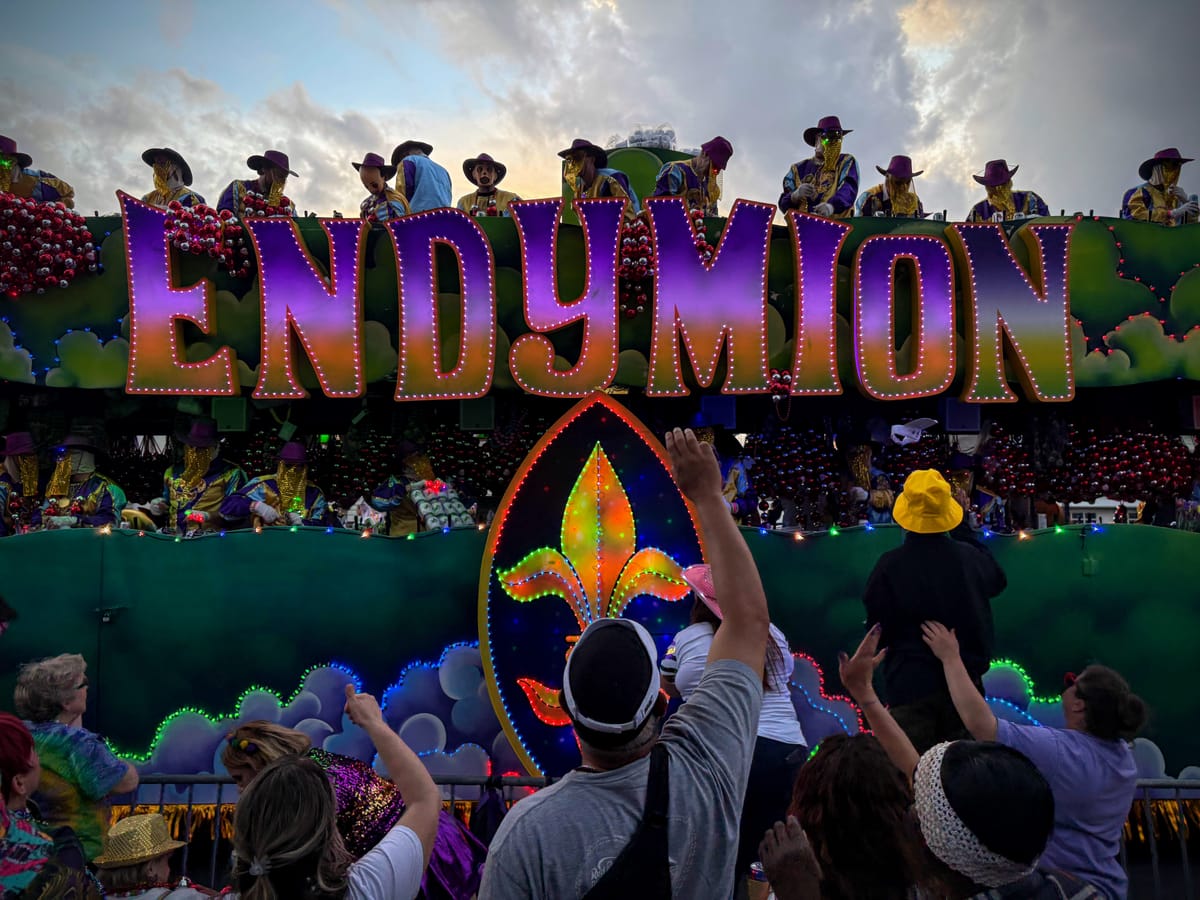
I like to compare the downtown walking krewes to float parades. For example, Chewbacchus is Endymion, an endless procession of sparkle and noise with an enormous crowd that makes it debatable whether the enterprise is worthwhile.
In the middle of the ‘20s, Bohème is Muses at its now-forgotten best. The crowd has grown big, but it’s chill. The parade glows, a greenlit patina cast over everyone that comes from nowhere and everywhere.
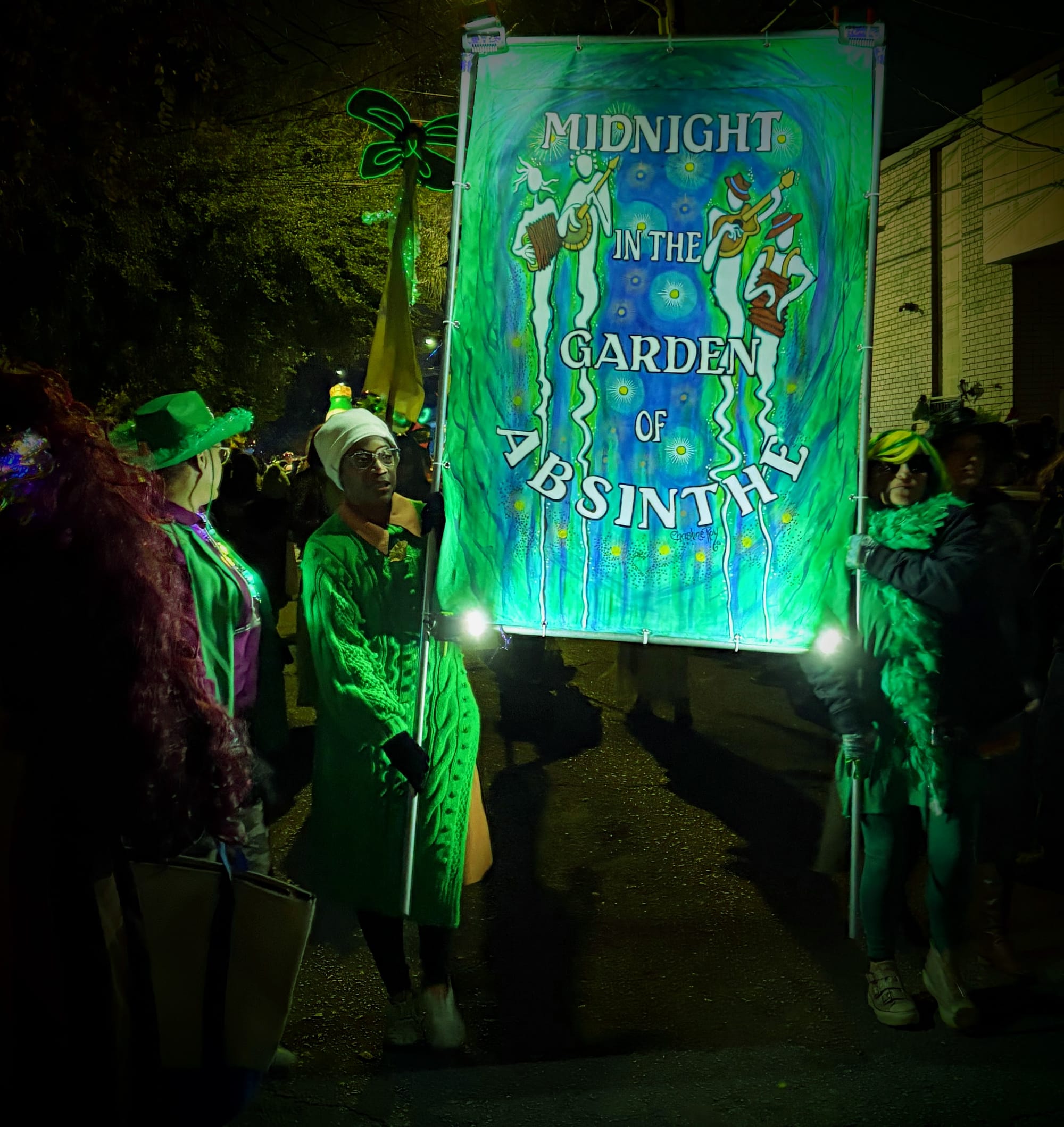
It’s a great coffee shop parade (by which I mean every year I end up buying a coffee somewhere in the Marigny so my kid can use the bathroom), for which you can get down to the route early, drink coffee, talk with people, and pop outside when you hear the sirens and music.
Its subkrewes — like Krewe D’Ensite (this year celebrating our great capital, Raton Bouge), Krewe da Bhan Gras (the single best recent addition to Carnival), and Phant Asia, among many others — add up to more than their collective sum. They create a story.
The story is about how the disparate parts that comprise New Orleans overcome obstacles to create a form of art that pleases our senses and says something about life in these times. That Bohème is composed of krewes that have arisen from some of the city’s often-overlooked cultures has made the parade particularly relevant since its founding, in 2018.
“Our history is also complex, with so much to honor and observe…” says Krewe da Bhan Gras, on its website. “…and a lot to address and resolve. We embrace it all…We honor the many South Asian countries we come from. We celebrate New Orleans, where we belong.”
Phant Asia emerged from the former Krewe of Mung Beans, its old name lost during a divorce from the increasingly troublesome Krewe of Red Beans.
Writer and New Orleanian E. M. Tran wrote, for Oxford American last year: “For the next carnival season, in 2025, the Krewe suggested that we were free to operate independently. To put it another way, we’d been asked to leave. The desire to part ways was mutual—somewhat tinged with acrimony and occurring a mere three months before Mardi Gras, the tipping point reached at the season’s first Mung Beans meeting in November, where differences between the Red Beans founder and Mung Beans krewe members became starkly evident.”
The differences could be summed up in a question. Tran asked: “Who is allowed to participate in the identity-making of New Orleans?”
So much of what Mardi Gras is is about identity-making. The old-line krewes emerged, in the mid-19th century, because the city's new Anglo-American (and mostly Protestant; recall the point above about Protestant joy) elite wanted to tame the wild celebrations of the Catholic French and Creole and Black peoples who owned the Carnival streets before 1857. They were, in other words, trying to remake the identity of a European-colonial city into a proper American one.
But the Carnival cycle continues; the wheel keeps turning. Every civilizing effort is met by subversion. Old-line all-white krewes, built by white supremacists, were subverted by the satirizing force of Zulu. All-male krewes were subverted by Venus, the first of the women’s krewes; the exclusive clubs were subverted by the all-access midcentury ones that rose with the middle class; stuffy Rex on his throne is followed by friendly families and neighbors riding home-decorated eighteen-wheelers; the Uptown float parades are subverted by the downtown walking parades. The downtown walking parades attract cool kid transplants. And walking krewes fighting for the Carnival place of Asian-New Orleanians break from that white-transplant-dominated world to forge their own way.
This tension was at the heart of the Mardi Gras vibes in 2026. The external pressures of America have weighed on New Orleans since the Louisiana Purchase, but sometimes the pressure is especially heavy. NOPD removed riders from two floats, both times for “aggressive throwing.” The second time was because Thoth members hurled throws at paradegoers in response to a protest sign.
Despite the tourism board image of our city as a single, united, crawfish-pounding, gumbo-guzzling entity, it is actually cosmopolitan beyond its pay grade. It’s a collection of peoples who make a people, and that more and different peoples are joining the mix is a sign that, even at this late hour, the city is still alive. Chitimacha, French, African, Anglo, Jewish, German, Irish, Sicilian, Vietnamese, Indian, Mexican, Central American, South American, and all the others: New Orleanians. Mardi Gras is what happens when the fever dreams of these divided and united people are collected and become life itself, with all the associated ugly and pretty.
The Cabrini Bridge on the bayou has been abandoned by the Dead Beans who once paraded there on Lundi Gras, as the aforementioned Krewe of Red Beans consolidates all its parts around Beanlandia. The wheel turns. The Bayou San Juan Social Club, built on the Lucha Krewe, has taken over. About the new Lundi Gras event, Thanh Truong wrote, for WVUE:
“It’s been amazing. People just love the energy. People love the music. People just love to party,” said Sergio Alvarado.
Alvarado is originally from Mexico, but has been living in New Orleans for more than a decade. You could say Mardi Gras is now part of him. On Lundi Gras, his chest hair was sculpted into the shape of a fleur-de-lis.
“Last year, I shaved it,” Alvarado said. “This year, I waxed it. And it was really painful.”
Musepocalypse Now
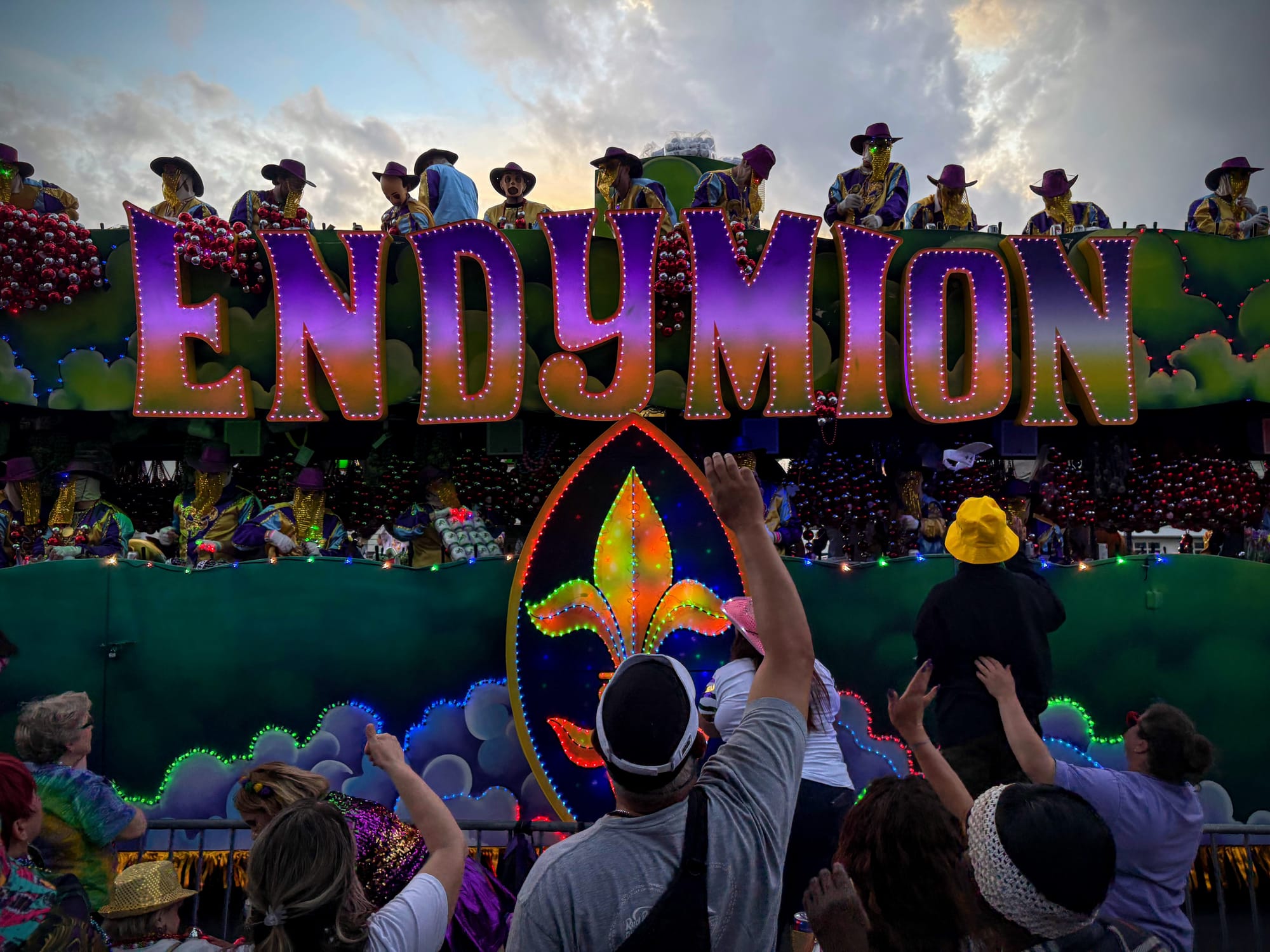
I wouldn't go to Endymion if I didn't live by Endymion, but my great-great-aunt once lived on Sherwood Forest, so I stay nearby and I go to Endymion. Normally, we walk from the house to the periphery of the impenetrable crowd and hang in the back, relying on riders’ vision and arm strength.
This year, people escorted us to the front. “We just stepped back here,” a lady said, gesturing for us to fill her vacated space.
“Y’all move up in front of us,” a man said, and refused to take no for an answer.
And so on until we were in the three-deep lineup at the epicenter, Orleans and Carrollton.
I am going to sound like a crazy person when I say this but the Endymion crowd at Orleans and Carrollton where me and the kids are has been… really nice and polite and stuff?
— Bradley Warshauer (@warsh.bsky.social) 2026-02-15T00:00:29.981Z
This was not expected Endymion behavior. After all, the Krewe of Chad originated here. So it was a surprise, but it happened, and others shared similar anecdotes. Part of the explanation for this micro-vibe change might be increased NOPD enforcement before the parade.
Certainly, making people adhere to city ordinances about ladder distances and tarps helps maintain the balance between the reality of public space and the use of that public space by individuals. Whatever the case, the relatively chill environment along this stretch of the Endymion route gave me the chance to really look at it as a parade again, and that’s something everyone might need to do.
Hating on Endymion — its “Don’t Stop Believin’” and “Sweet Caroline” energy — has been cool, at times so cool that the parade has become underrated. Yeah, it’s big, and yeah, it’s an overwhelming spectacle, but its boisterous neon extravagance is layered over well-thought-out themes and gorgeous floats. And there’s no sign of any letup.
I can’t say the same about twenty-first century favorite Muses.
This year — and over the past half-decade or so — there was no access to any part of Magazine. Last year I stepped aside, during a lull, to let someone cross the street, and the person next to me glared, as though I were trying to take away her imagined zone of control. This year a friend raised a sign to attract the attention of a rider friend, and a man yanked the cardboard from her hands and threw it into the street; it had momentarily passed in front of his illegally-placed ladder. At Muses 2026, people looked at one another with distrust, suspicion; everyone was a potential invader.
And the parade itself seems tired. The elements are all there – the satirical themes, the subkrewes and dance clubs, the neon butterflies – but the floats seem aged now, the sounds muted, its old constant glow, once much like the green tint that follows Bohème everywhere it goes, fading. It feels like people will punch you for a shoe only to turn around and try to sell it for fifty bucks on Ebay. At some point, who cares? Nobody will beat you up over a Freret mask, and they’re just as pretty.
Maybe it’s as simple as sweeping the worst stretches of the Muses route to enforce city ordinances. As with parts of Endymion 2026, this might re-balance the public-private duality of the route. Or maybe the situation will just keep getting worse until enough of us shrug and stop going, and it’ll all take care of itself.
The wheel of Carnival keeps turning, you know?
3. Why I Have Cried in a Popeyes Drive-Through at the End of Mardi Gras Day
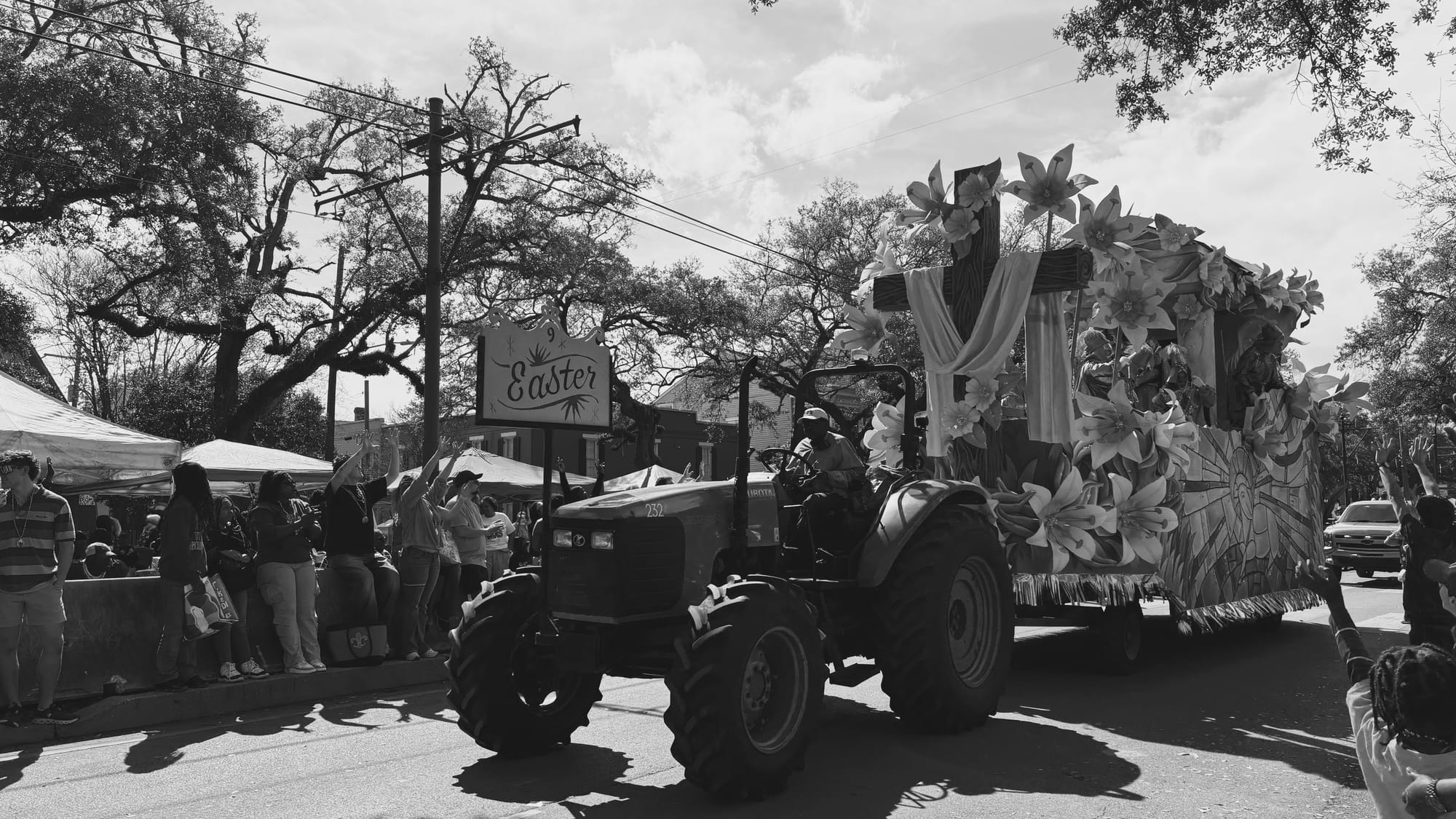
It takes work to make this all happen, and you have been at work for weeks.
Finally, on February 17, it all ends. You're up before dawn, getting ready. You make breakfast, you drink mimosas, you head Uptown, or downtown, you find your place on the route or you mask and board your float or you join a costumed horde and dance to the Mississippi and watch someone pour ashes into the flowing waters.
The collective fever dream is not a dream at all. It's more alive than real life. The everyday shit is what we have to survive so we can get here again, because survival is insufficient.
You feel the joy and suffering and the connections you have made or broken or reforged and all the exhaustion and satisfaction rising in you. At some point, it will release itself in a moment of catharsis.
This is the Mardi Gras feeling you first identified early in your Carnival career, maybe as a child, when you were falling asleep in the back of your parents’ station wagon after a parade: it is a kind of fullness that replaces the hollowness of routine, a sense of lived-in-reality that fills the emptiness where so many days evaporate without leaving memories.
Maybe the moment of catharsis happens when you are alone in your car, stuck in the drive-in line of the Popeye’s at Carrollton and Earhart, listening to the WWOZ replay of Dr John’s 1994 Mardi Gras special. When the catharsis hits, the feelings are too big for your body to contain so they run out of you as water, in sobs.
Midnight comes. They sweep you out of the street. The cathedral bells ring out over the river. It is Ash Wednesday now, and you are dust.